
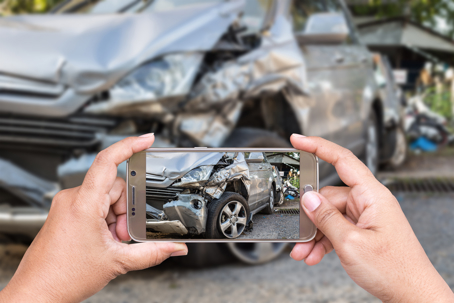
Your cell phone is almost certainly within arm’s reach right now. After a car accident, that same phone can be one of the most powerful tools you have for protecting your legal rights — or, if it was in your hand at the time of the crash, one of the biggest threats to your case. The difference comes down to timing: before the collision versus after it.
The Double-Edged Sword
Let’s get the hard truth out of the way first. If you were using your phone when the accident happened — texting, scrolling, checking a notification, anything — that phone usage can and will be used against you. Florida law prohibits texting while driving, and cell phone records are discoverable in litigation. The other side’s attorney can subpoena your phone records and app usage data to show that you were distracted at the moment of impact. If the evidence shows you were on your phone, it can reduce or even eliminate your ability to recover damages, because a jury may find that your distraction contributed to or caused the accident.
This is not a hypothetical. Defense attorneys routinely pull cell phone records in accident cases, and timestamps accurate to the second can place a text message or app activity at the exact moment of a crash. If your phone was the reason you did not see the other driver, that is a fact that will come out.
The takeaway is simple: put your phone down while you drive. No text, social media post, or email is worth your life or your legal rights. But once the accident has happened and you are safe, your phone becomes your best friend.
After the Crash: Why Documenting the Scene Matters
Evidence disappears fast after a car accident. Skid marks fade. Debris gets swept up. Vehicles are towed. Traffic patterns change. Witnesses leave. The conditions that existed at the moment of the crash — the position of the vehicles, the damage, the road conditions, the traffic signals, the weather — can be gone within hours or even minutes. Once that evidence is lost, it is gone forever.
Your cell phone camera can preserve all of it. The photos and videos you take at the scene may end up being the single most important evidence in your case — more persuasive than any expert reconstruction, because they show exactly what things looked like in real time.
What to Document With Your Phone
If you are physically able to do so after an accident — and your safety is always the first priority — use your phone to capture as much of the following as possible:
Vehicle Damage
Photograph all vehicles involved from multiple angles. Get close-up shots of the damage as well as wider shots that show the overall condition of each vehicle. Make sure to capture the point of impact on every vehicle. These photos establish the severity of the collision and can directly counter any argument that the crash was too minor to cause injury.
The Scene and Road Conditions
Take wide-angle photos of the intersection or roadway. Capture traffic signals, stop signs, lane markings, speed limit signs, and any obstructions to visibility. If the road is wet, if there is construction, if a sign is obscured by overgrown vegetation — photograph it. These details can prove how the accident happened and who was at fault.
Vehicle Positions
Before the vehicles are moved, photograph where they came to rest. The final resting positions of the vehicles tell a story about the speed and direction of impact. Once the cars are moved for towing or to clear the roadway, this evidence is permanently lost.
Skid Marks, Debris, and Road Evidence
Tire marks, broken glass, fluid spills, and scattered car parts all help reconstruct what happened. Skid marks can indicate whether a driver attempted to brake and how fast they were going. This physical evidence on the roadway is typically cleaned up within hours.
Your Injuries
If you have any visible injuries — cuts, bruises, swelling, bleeding — photograph them. Continue taking photos in the days and weeks that follow as bruises develop and injuries become more apparent. A picture of a bruise taken the day after an accident is powerful evidence that is hard for the defense to dispute.
The Other Driver and Their Information
Take a photo of the other driver’s license plate, driver’s license, and insurance card. This ensures you have accurate information even if the other driver gives you incorrect details at the scene. If there are commercial vehicle markings, a company name on the door, or a DOT number, photograph those as well.
Witnesses
If there are witnesses, ask for their names and phone numbers and save the information in your phone. Witnesses who saw the accident happen can be critical to your case, but people leave the scene quickly and can be nearly impossible to track down later.
Consider Taking Video
A short video walkthrough of the scene can capture details that individual photos might miss. Walk slowly around the vehicles, pan across the roadway, and narrate what you see if you are able to. Video also captures ambient conditions like lighting, weather, and traffic flow in a way that still photos cannot. Many of our clients’ cases have been strengthened by a simple 30-second video taken on their phone at the scene.
Your Photos Are Timestamped Evidence
One thing many people do not realize is that every photo taken on a modern smartphone contains metadata — embedded information that records the exact date, time, and GPS location where the photo was taken. This metadata makes your accident scene photos difficult to challenge in court. The defense cannot easily argue that your photos were taken at a different time or place when the data embedded in the image file says otherwise.
What Not to Do With Your Phone After an Accident
While your phone is invaluable for documenting the scene, there are a few things you should avoid. Do not post about the accident on social media. Anything you post on Facebook, Instagram, or X can be discovered by the opposing party and used against you. A casual post saying you feel fine, or a photo of you smiling at dinner the next day, can be taken out of context to undermine your injury claim. Keep your documentation private and share it only with your attorney.
Similarly, do not give recorded statements to the other driver’s insurance company using your phone. You are under no obligation to do so, and anything you say can be used to minimize your claim. Politely decline and let your attorney handle communications with the insurance adjuster.
Contact Watson Firm
If you have been involved in a car accident in Northwest Florida, the evidence you preserve in the first few minutes after the crash can shape the entire outcome of your case. If you have photos, video, or other documentation from the scene, bring it to your initial consultation — it may be more valuable than you think. Contact Watson Firm today to discuss your case and learn how we can help protect your rights.
Disclaimer: This article is for informational purposes only and does not constitute legal advice. Every case is different, and the outcome of any legal matter depends on the specific facts and circumstances involved. If you need legal advice, please consult with a qualified attorney.